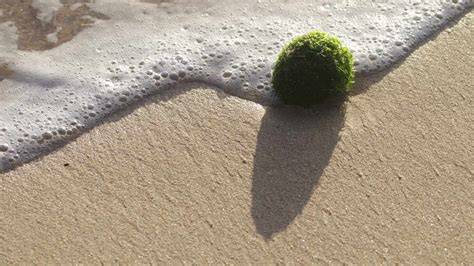
Marimo Moss Balls are rare algae growths that only form in a few lakes in Iceland, Scotland, Japan and Estonia. Many cultures consider them to be good luck and treat them almost as pets (you can think of them as the aquatic equivalent of a "Pet Rock").
Origine, natura e classificazione
Marimo moss balls are not moss-and they’re not plants at all. Aegagropila linnaei, a rare, slow-growing, filamentous freshwater algae that naturally forms dense, velvety spheres in cold, alkaline lakes like Lake Akan in Japan. Proper marimo moss ball plant care hinges on replicating those stable, low-energy conditions-not treating them like terrestrial plants or decorative aquarium ornaments.
Marimos are prokaryote-derived green algae-photosynthetic cyanobacteria relatives-with no roots, stems, or vascular tissue. Their spherical form emerges only under specific hydrodynamic conditions: gentle lake-bottom currents that tumble young algal filaments into tight, self-reinforcing balls. In home settings, that shape must be maintained manually-no current, no roll, no sphere.
Ambiente ideale e luce
Marimo moss balls are not moss-and they’re not plants at all. Aegagropila linnaei, a rare, slow-growing, filamentous freshwater algae that naturally forms dense, velvety spheres in cold, alkaline lakes like Lake Akan in Japan. Proper marimo moss ball plant care hinges on replicating those stable, low-energy conditions-not treating them like terrestrial plants or decorative aquarium ornaments.
Marimos thrive between 12°C and 20°C (54°F-68°F)-the temperature band of their native Hokkaido lakes. They tolerate brief dips to 6°C (43°F) and spikes to 23°C (73°F), but sustained exposure outside 10-22°C triggers metabolic stress. Above 24°C, respiration exceeds photosynthesis; filaments begin autolysing. Below 8°C, cellular fluid viscosity increases, halting nutrient diffusion. During heatwaves (>28°C ambient), place marimos in a shallow dish lined with damp, rinsed sphagnum moss (not peat moss), cover loosely with breathable fabric, and store in the coolest room-ideally a basement or interior closet.
Marimos evolved in the dim, diffused light of deep, clear northern lakes-never under full sun or bright LEDs. Their ideal light intensity is 50-150 lux, equivalent to north-facing window light on an overcast day or a 5-watt LED bulb placed 1.5 meters away. Direct sunlight-even for 20 minutes-causes rapid photoinhibition: chlorophyll degrades, filaments bleach white or yellow at the surface, and internal heat buildup triggers necrosis. Instead: position marimos in translucent containers (glass or acrylic) on east-facing surfaces, inside closed terrariums with frosted glass, or on desks 2 meters from unshaded windows. If using artificial light, choose a 2700K warm-white LED at 3 watts, mounted overhead at ≥1.2 m, and limit exposure to 4-5 hours daily. Rotate the ball 90° each time you check it-this ensures even, low-stress photosynthesis across all filaments.
Acqua, fertilità e cambi d’acqua
Tap water is the single largest cause of marimo decline. Municipal supplies contain chlorine (Cl₂), chloramine (NH₂Cl), and fluoride-all toxic to Aegagropila linnaei. Chlorine damages cell membranes within hours; chloramine persists for days and disrupts nitrogen metabolism. Even “dechlorinated” water treated with sodium thiosulfate may leave residual ammonia, which marimos cannot process. Change water weekly-no exceptions. Warmer ambient temperatures accelerate bacterial growth and organic leaching from the marimo’s outer layer. Let new water sit uncovered for 24 hours before use only if it’s spring water; RO or rainwater requires no aging. Never top off evaporated water: this concentrates minerals and organics. Always replace 100% of the volume.
Use distilled white vinegar (5% acetic acid) to clean containers monthly: soak glass vessels for 10 minutes, rinse thoroughly with RO water, and air-dry. Algae biofilm buildup on container walls competes for light and alters local pH-both harmful to marimos. Marimos moss balls require zero fertilizer. They absorb dissolved inorganic carbon (CO₂), nitrate, and phosphate directly from water-but only at trace levels found in clean spring or re-mineralized RO water. Adding liquid fertilizers, root tabs, or “algae boosters” floods the system with excess nitrogen and potassium, triggering bacterial blooms, surface slime, and filament sloughing.
Manutenzione, movimento e igiene
Rolling is essential-not optional. Without consistent tumbling, one hemisphere receives more light and grows faster, causing flattening or lopsidedness. Uneven growth also creates anaerobic pockets where sulfate-reducing bacteria proliferate, emitting hydrogen sulfide (rotten-egg odor) and turning inner filaments black. Roll gently-never squeeze, twist, or press. Use clean, cool, wet fingers or soft silicone tongs. Perform rolling every 48-72 hours, rotating the ball fully (360°) while submerged. For best results, roll underwater in its storage container: this prevents air pockets and maintains hydration. Never remove marimos from water for “air drying” or “display.” They desiccate in under 90 seconds. If you must relocate them temporarily, place in a sealed container with 2 cm of fresh, cool water-never wrap in paper towels or plastic wrap.
Forma, dimensioni e propagazione
Marimos grow ~5 mm per year under ideal conditions. Propagation is rarely needed and should only occur if a ball exceeds 12 cm in diameter and shows signs of internal splitting. Division is mechanical-not biological-and carries high failure risk. Success rate: ~40% under expert conditions. Most failures stem from blade contamination or insufficient post-cut rolling. Never divide marimos smaller than 6 cm-insufficient biomass to sustain two independent colonies.
Guida stagionale e pratiche consigliate
Winter (Dec-Feb, Northern Hemisphere): Reduce rolling frequency to every 5 days (lower light = slower growth). Keep away from drafty windows-cold air contact causes surface ice crystals that rupture filaments. No water temperature adjustments needed if indoor temps stay 16-20°C. Spring (Mar-May): Increase rolling to every 48 hours as daylight lengthens. Inspect for early brown spots-often linked to rising indoor humidity and airborne spores. Summer (Jun-Aug): Prioritize cooling. Store marimos in the coolest room, avoid direct AC airflow (causes evaporation), and consider adding a small, submersible aquarium fan set to lowest speed-creates gentle surface agitation without turbulence. Fall (Sep-Nov): Resume weekly water changes if you paused them in summer. Test pH-fall rainwater runoff can acidify stored spring water supplies.
Miti comuni e chiarimenti
Myth 1: “Marimos clean aquariums.” False. Unlike Vallisneria or Hygrophila, marimos lack roots and nutrient uptake mechanisms for nitrates. Studies (Kawamura et al., Limnology, 2018) show no measurable reduction in NO₃⁻ or NH₄⁺ in tanks containing marimos alone.
Myth 2: “They need fish to thrive.” False-and dangerous. Fish waste raises ammonia and phosphate; fin-nipping species (e.g., bettas) shred filaments. Marimos coexist best with nerite snails (Neritina spp.) in species-only tanks.
Myth 3: “Drying and rehydrating makes them ‘fluffier.’” False. Desiccation ruptures cell walls permanently. Rehydration swells damaged filaments, creating temporary fullness-but accelerates long-term fragmentation.
Чastie domande e risposte
How often should I wash my marimo moss ball? Rinse gently under cool, dechlorinated water once weekly during water changes. Do not scrub, brush, or use soap. If surface slime appears, reduce light and increase water change frequency to every 3 days for one week.
Can marimo moss balls live in a fish tank? Yes-but only in cold-water, low-bioload tanks (e.g., white cloud mountain minnows or weather loaches) with no substrate-dwelling fish. Avoid tanks with goldfish, cichlids, or shrimp-they disturb the marimo’s surface or compete for resources.
Why is my marimo turning brown on the bottom? Bottom browning signals poor water circulation or sediment buildup. Lift the marimo daily to check the base; if brown, pour out old water, rinse the container, and refill with fresh spring water. Never let marimos rest directly on tank substrate.
Do marimo moss balls need air pumps or filters? No. Air pumps create damaging turbulence. Filters are unnecessary in single-marimo vessels. In community tanks, use only sponge filters set to minimal flow-marimos cannot withstand water movement above 0.5 cm/sec.
Domanda di fertilità
Marimos need zero fertilizer. They absorb dissolved inorganic carbon (CO₂), nitrate, and phosphate directly from water-but only at trace levels found in clean spring or re-mineralized RO water. Adding liquid fertilizers, root tabs, or “algae boosters” floods the system with excess nitrogen and potassium, triggering bacterial blooms, surface slime, and filament sloughing.
Conclusioni operative
Marimo moss ball plant care succeeds not through complexity, but through disciplined simplicity: cool water, diffuse light, gentle motion, and absolute avoidance of terrestrial plant assumptions. They reward patience-not intervention. When you lift a vibrant, springy sphere from its jar, feeling its dense, living weight and smelling that clean, green scent, you’re holding a piece of ancient lake ecology-adapted, not tamed. Remember: no fertilizer, no sun, no tap water, no squeezing, no silence. Roll it. Watch it. Respect its rhythm.
Si è rotto il Marimo: come legarlo!
tags: #marimo #moss #ball #fertilizer